

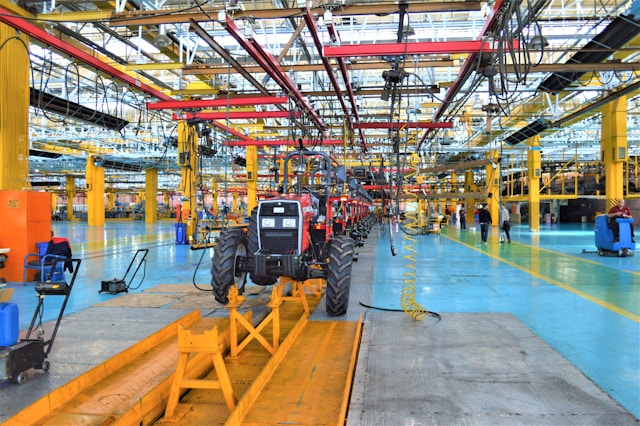
"Lack of labor is killing us."
The U.S. manufacturing sector continued to expand in June, while prices have hit a record high and employment contracted for the first time in six months, according the Institute for Supply Management’s monthly Report on Business for the manufacturing sector. The ISM reports its index of manufacturing activity eased back a half percent in June to a reading of 60.6% in the sector’s thirteenth straight month of expansion (any reading over 50% indicates expansion).
New orders and production expanded strongly in June. Meanwhile, raw materials inventories grew, and both exports and imports advanced over last month. Employment, which had been in expansion for several months, saw a contraction, as manufacturers struggle to fill more than 800,000 open positions in the sector.
Meanwhile, the Prices Index shot up 4.1% to 92.1%, which is the highest reading since July of 1979 when the PI reached 93.1%.
Optimism among manufacturing executives was strong, though not as strong as in May. The ISM registered 16 positive comments for every one negative comment in June. By contrast, 36 positive comments were recorded in May for every one negative comment.
Timothy Fiore, Chair of the ISM committee said that survey panelists reported their companies and suppliers are struggling to meet heightened demand. “Record-long raw material lead times, wide-scale shortages of critical basic materials, rising commodities prices and difficulties in transporting products are continuing to affect all segments of the manufacturing economy,” he says. Fiore also refers to worker absenteeism, parts shortages and scarcity of labor as limiting growth in the sector.
One executive in the machinery sector reported, ““Higher prices, inflation and lack of available labor are impacting all organizations in our supply chain.”
Seventeen of eighteen industries included in the ISM’s survey reported growth in June, with growth strongest in furniture & related products; machinery; electrical equipment, appliances & components; and computer and electronic products.
The ISM listed several commodities in short supply, including aluminum; printed circuit boards; packaging supplies; steel containers; semiconductors; and PVC resins. steel; printed circuit boards, semiconductors, plastic resins, plastic containers and more.
Supply shortages were mentioned numerous times by industrial executives in response to the ISM.
Said one executive in the electronics sector, “Supply chain constraints, from mechanical to electronics (products) continue to be challenging, from both availability and logistics perspectives. Inflationary pressure on materials due to supply and demand imbalance. Electronic components by far the biggest challenge, with lead times going from 16 weeks to 52-plus weeks."
One company in the fabricated metals sector noted that customer ordering habits have shifted to include long-term demand. “Customers are now placing orders for fourth quarter 2021 and first quarter 2022 due to global supply chain issues.”
Prices also remained a sticking point for many companies. A number of commodities were up in price, including many types of steel, aluminum, corrugated packaging; rubber products; paper and more.
Demand Strong in June
The ISM’s New Order Index remains well above the expansion line, hitting 66% in June. Although this is 1% lower than May’s reading on 67%, the index reflects unprecedented demand for industrial products. May’s reading marks the thirteenth consecutive month of growth.
Related: Resources for Building a More Resilient Supply Chain
Fifteen of eighteen industries reported an increase in new orders for June, led by furniture & related products; printing & related support activities; transportation equipment; and miscellaneous manufacturing.
Production Heats Up
Production surged in June as manufacturers scrambled to keep up with demand, with the Production Index registering 60.8%--up 2.3% from May. This represents the thirteenth straight month of growth for manufacturing output.
Fourteen of eighteen industries reported advances in output in June, led by petroleum and coal products; electrical equipment, appliances & components; nonmetallic mineral products; machinery; and chemical products.
Employment Contracts as Labor Scarcity Persists
After six straight months of expansion, the ISM’s Employment Index fell into contraction, registering a reading of 49.9%--just under the 50% mark. However, the contraction in employment is likely more to do with labor scarcity than layoffs. Said Fiore “An overwhelming majority of panelists indicate their companies are hiring or attempting to hire, with approximately 36% of comments expressing difficulties in filling positions.”
Many of the comments from respondents addressed labor issues, with one executive in the primary metals industry reporting, “We continue to be oversold, based on what we are currently capable of producing. Lack of labor is killing us.”
Ten of eighteen industries reported employment growth in June, with growth strongest in electrical equipment, appliances & components; plastics & rubber products; furniture & related products; miscellaneous manufacturing; fabricated metal products.
Looking for new suppliers or competitive quotes? Search, source & quote for free with IndustryNet.
