


Nearly half of all sanitary pumps purchased in food and beverage are sanitary pumps, and almost all of the pumps used in pharmaceutical applications need to meet a sanitary standard such as 3-A.
Added to this is the range of technical challenges faced when pumping oils, chocolate, cosmetic lotions and creams means that selecting the right pump is vital.
Damage to the liquids being pumped can disrupt downstream processes and cause wastage at unacceptable levels. Ruined end-product can be expensive.
So can missed shipping deadlines which can happen when product needed for an urgent shipment is ruined.
To help you avoid all of these and more problems we’ve written this sanitary pump buyers guide to help you select the right sanitary pumps for each of your applications while not having to spend hours researching and consulting with endless engineers and other experts.
What Challenges Face The Sanitary Pumps Buyer?
When looking at the market for sanitary pumps it is critical for buyers to avoid these problems.
Meeting 3-A Sanitary Standards. The options available for the sanitary pump market are limited by the range of pumps that meet 3-A Sanitary Standards.Not all pumps that comply with the 3-A standard are created equal. Some have higher purchase prices, some are more energy efficient and some are harder to service than others. Meeting the standard is ‘minimum ante…’ just because a pump meets the standards doesn’t mean it is right for you – not all manufacturers and suppliers understand this.
Operating Costs. Operating costs are something that you are stuck with for the life of the pump. At a minimum, 40% of the money spent on a pump will be for maintenance and power over the life of the pump. The ongoing operating and maintenance costs can be even higher if the system isn’t built to keep operating costs to a minimum. Total cost of ownership has to be factored in at purchase time when management is always looking for ways to cut costs.
Managing Downtime AND Preventing Breakdowns. When purchasing sanitary pumps you have two main ways to prevent breakdowns. The first is to select the best pump for the job which will minimize frequency of breakdowns and outages. The second way is to make sure that adequate redundancy is available so that when a breakdown does occur that it doesn’t cause the operation to grind to a complete halt.Both of these options need to be discussed during the specification and recommendation stage of the purchase.
Lead Times. Speaking from experience – during an outage, pump purchasing decisions can be made almost entirely based on who can get a pump to me the fastest. Finding a supplier who has a large inventory of parts ready to ship and offers fast turnaround on deliveries while still offering a high quality product should be a task undertaken by many sanitary pumps buyers. Some manufacturers have longer lead times than others – delays in delivery can lead to delays in installation which can delay your project.
Compatibility. With proprietary coupling systems used by every manufacturer, it locks a buyer into a single supplier for life unless they can find a competitor who has the capacity to retrofit. If you are assessing a new manufacturer – how easily their pumps can be installed into existing lines needs to be assessed
Inventory of Parts – A manufacturer or supplier who is willing to inventory a large range of parts can be a godsend in this day and age. When you need a part, you need it now. It can be painful waiting weeks or even months for a part because the manufacturer doesn’t have any production capacity in the meantime and doesn’t have what you need on the shelf.
What Should Happen Every Time We Buy A Sanitary Pump?
In order to get the best possible recommendations when you are looking for a pump for a new application or better performance/ lower operating cost/ increased reliability on an existing line then here is the process your pump supplier needs to follow:
Once everything is on file it is a much faster process to specify replacements. We just have to update the files and then make a new recommendation.
General Design Considerations
Before we talk about the actual pump selection, it is important to understand how and where the pump will be installed in order to pick the right pump for the application.
1. Nature Of The Application? Does the application require constant flow and pressure or do you have variable flow or pressure? Is it a continuous or intermittent service? Is it mission critical? Do you need 99% uptime? 99.9% uptime? Or Better? What redundancy exists? What redundancy do we need to get you, your required uptime?
2. What Are The Space Requirements? How much space do you have in the mechanical room? When space is tight, it will force the selection of smaller pumps or a vertical mount pump.
3. What Is The Quality Of Your Power Source? In Atlanta for example at the end of the grid, you may not get 460V, or you may have voltage that fluctuates all the time. Depending on how “clean” your power is certain devices will need to be used in the control panel to stabilize the power feeding the motor.
4. What Is Your Life Expectancy For The Pump? Is this a temporary service? A critical service? What is the life that you expect to get out of this pump? The pump we’d recommend if you need a pump for a service lasting 3 months is different to the pump we’d recommend if you want it to run for 20+ years.
5. Energy Efficiency –When motor size exceeds 50hp reducing the power consumption by 5-15% can save you thousands of dollars a year and can have a dramatic effect on total cost of ownership. With the drive to become greener, energy efficiency always needs to be discussed on even the smallest pumps.
6. Budget – Not all pumps have the same design or materials of construction. Understanding your budget will allow your supplier to come up with options within your budget rather than wasting your time with options that are outside your budget
Once a pump engineer understands your general situation they then need to understand the technical details.
Pump Design Considerations:
At a minimum, the following information is required in order to get an accurate specification:
1. Flow (GPM or L/S, M3/Hr)
2. TDH (FT, M, KPa)
3. Fluid name and temperature
4. Pump speed 9. Elevation
5. Specific gravity and viscosity
6. Horizontal or vertical installation
7. Piping materials being used
8. Site Power and motor data
9. Elevation
With all of this information it becomes possible to recommend a pump for an application. Once we have this data on file the next time you need a pump for this application it becomes a simple task to make sure the information is still current and then make recommendations based on the new information.
At this point it is also possible to make suggestions about alternative models that might give you a better solution or save you money either upfront or over the life of the pump.
Why Pye-Barker Recommends & Supplies AMPCO Sanitary Pumps
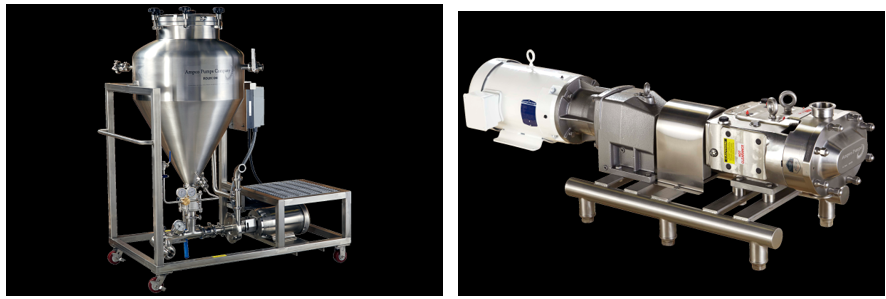
By bringing on AMPCO Pumps into their range Pye-Barker is now able to supply sanitary pumps (both positive displacement and centrifugal) for both the pharmaceutical and the food and beverage industries.
AMPCO’s range also includes industrial mixers and blenders and speciality products for the brewing and wine making industries.
Here’s what we like about AMPCO’s range of sanitary pumps
• Their positive displacement pumps handle
-Capacities from 0.1 to 850 gpm/193 m3/h,
-Pressures up to 500 psi/34 BAR,
-Viscosities from 1 to 1,000,000 centipoise (cP).
-even the toughest applications such as chocolate, and cosmetic creams and lotions
-Delivery usually within 1-3 weeks (sometimes less)
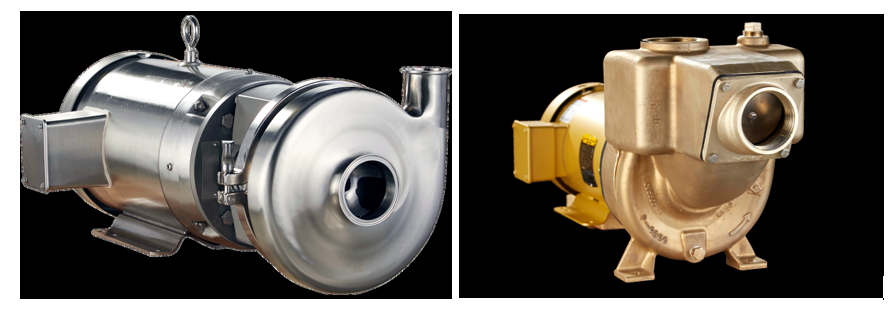
• Their centrifugal range includes
-AC Series: Robust in offering and is the staple of the centrifugal product line. Add an innovative shaft design and you’ll get the AC+ Series Pumps. With the AC/AC+ Series, you’ll get our best-selling centrifugal pump. They deliver on ease-of-maintenance, reliability, enhanced longevity and performance.
-L Series: High efficiency, high pressure pumps including a metric line. All offer distinct and meticulously crafted seal configurations to meet the most stringent application and performance requirements. The comprehensive L Series is designed for ease of maintenance and provides options for gentle product handling up to 1200 cPs.
-M Series: Offers superior hydraulic design and is ideal for hot oil applications. Both the M Series and L Series pumps are a good fit for high efficiency, heavy duty centrifugal pump applications when high-efficiency performance is a must.
-SP Series: Well suited for clean-in-place (CIP) applications. To maintain performance and flow, the SP Series is specifically designed with a unique wagon wheel impeller configuration. The SP is successful in attaining high suction levels even when processing products with entrained air.
-D Series: Meet industry’s need for cleaning and sanitizing solution pumps. It’s the industry standard for CIP supply. The D Series offers an innovative double volute design option to reduce air binding.
• One of the easiest to change O-ring seals on the market
• AMPCO pumps can be easily retrofitted into existing lines with a minimum of hassle – in many cases one of AMPCOs pumps will be a simple drop-in replacement
• AMPCO pumps are engineered to be some of the most efficient on the market
• Most of AMPCO’s parts ship the next day and if you know the part number of a non-AMPCO pump we can see if they can match it – and ship it to you the next day
• AMPCO will remanufacture an existing pump in 2 weeks or less with a one year manufacturer’s warranty
• A range of remanufactured ‘premium economy pumps’ on the shelf ready to ship the next day
What Applications Are AMPCO Pumps being used for at the moment?
AMPCO’s positive displacement pumps are being used for:
• Bakery – Dough, fats, fruit filling, icing, oil, yeast
• Beverages – Beer, fruit concentrate, fruit juices, mash, wine
• Confectionary – Chocolate, cocoa butter, corn syrup, gelatin, sugar
• Canned Foods – Tomatoes, baby food, jams, jellies, mayonnaise, potato salad, pudding, relish, stews
• Cosmetics – Creams, emulsions, jellies, lotions, shampoo, toothpaste
• Dairy – Butter, cream, curds, ice cream, margarine, milk, soft cheese, yogurt
• Dressings – Mayonnaise, other sauces, ketchup
• Flavorings – Concentrates, syrups
• Meats – Broth, fats, gelatin, pet foods, sausage fillings
AMPCO’s Centrifugal pumps are being used for
• Food and Beverage – Fruit juices, fruit concentrate, mash, high fructose corn syrup, liquor, wine, beer, wort, yeast, bottled water, carbonated beverages, marinade solutions, red water chillers
• Oils – Salad, frying, cooking
• Dairy – Cream, ice cream, buttermilk, milk, whey
• Beauty and Personal Care – Soaps, lotions, aerosols, cosmetics, shampoo, mouthwash
• Confectionary – Candy, corn syrup, chocolate, sugar solutions
• Pharmaceuticals & Biotech – Water for injection, injectables, intravenous fluids
What To Look For When Assessing A Pump Systems Provider
Based on 150 years of engineering experience at Pye-Barker, here are some of the top considerations for selecting a pump systems provider – they should help you evaluate your vendor and get you the best possible result:
1. Who is going to be designing the system for us?
2. How much experience do they have designing similar systems?
3. What will my projected total cost of ownership be?
4. Can it be made better?
5. How big a range of products can they access?
6. In situations where space is at a premium: Is the system occupying the smallest footprint possible?
7. Who is going to be building this system for us?
8. How much experience do they have building, testing and commissioning systems like this?
9. What are our costs if the project is delayed?
10. What is the cost of lost production if the project is delayed?
11. Who is going do the maintenance in the long term?
12. Who is responsible for the system long term?
13. Who will I be dealing with if there are warranty problems? (Do I have a single contact for the whole system or will I be chasing component manufacturers?)
About Pye-Baker’s Pumps Systems Consulting, Supplying And Installation
Pye-Barker can optimize your entire plant’s pumps and other positive displacement technologies. We can advise you on the design, specification, provide all the parts for your pump system, install them and maintain them for you. With 150 years of positive displacement engineering experience. There isn’t an application we haven’t had direct experience with already and worked out how to custom design and build a system for it.
Pye Barker specializes in managing the entire process of designing, building and repairing pump systems so that their clients never have to worry about them during any part of their lifecycle.
All Pye-Barker designs that are built and installed by Pye-Barker are guaranteed to get the specified performance, otherwise Pye-Barker will keep working with you, until your pump system works as specified even if it means installing a whole new pump.
What To Do Next
If you are planning to build, upgrade or add a pump system, the first step to getting the right performance is a no-cost, no-obligation “Design Needs Assessment.” To schedule your “Design Needs Assessment” call 404-363-6000, or send an email to sales@pyebarker.com or go to https://pyebarker.com/contact/#quote
This post was brought to you by Pye-Barker Engineered Solutions in partnership with IndustryNet.
Have industry knowledge like this to share? IndustryNet can help you reach the right audience. Learn more about our marketing solutions.
