

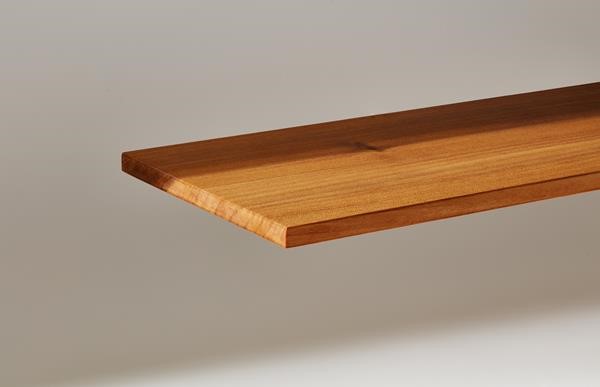
Imagine a material that's as strong as steel but lightweight and designed to resist high humidity, fire, rot, and pests. That's Superwood, the latest innovation from Maryland-based InventWood, and it's about to shake up the way we think about construction and manufacturing.
Superwood’s journey from concept to commercialization began in a University of Maryland lab in 2018, when materials scientist Liangbing Hu discovered a way to transform ordinary wood into a high-performance structural material. His breakthrough involved modifying the molecular composition of timber to enhance its strength, a process that would later become the foundation of InventWood’s technology.
The key to Superwood’s strength lies in its cellulose fibers, which are naturally strong but typically held together by lignin, a polymer that gives wood its rigidity. Hu’s process involves removing most of the lignin using food-grade chemicals, allowing the cellulose fibers to form stronger hydrogen bonds when compressed. This compression step is critical—it densifies the material up to four times, but the resulting strength increase is closer to tenfold, thanks to the additional molecular bonding.
Initially, Hu wasn’t sure how to bring his discovery to market. As interest in the material grew, he refined the process, reducing production time from over a week to just a few hours. Eventually, he licensed the technology to InventWood, which secured $15 million in Series A funding to scale production.
"SUPERWOOD demonstrates what's possible when we combine nature's most highly evolved structure with revolutionary science," said Alex Lau, CEO of InventWood in a statement. "This funding enables us to scale production of a material that will fundamentally change how we build, creating structures that are stronger and lighter than steel while retaining all the biogenic qualities people have treasured in wood for millennia."
Now, Superwood is set for mass production, with its first applications focused on facade materials for commercial and high-end residential buildings. But the company has bigger ambitions—future uses could include structural beams, exterior siding, decking, and even industrial components.
With its strength-to-weight ratio ten times greater than steel, Superwood is poised to disrupt traditional materials while offering a sustainable, carbon-friendly alternative. As production ramps up, it could become a staple in construction, manufacturing, and industrial design.
For procurement teams and manufacturers, this could be a game-changer. Superwood is lighter and more sustainable than traditional materials, potentially reducing both shipping costs and environmental impact. And as production scales, there’s a strong chance it could become a cost-effective alternative to steel in certain applications.
With manufacturing ramping up soon, Superwood is set to make waves in sourcing and industrial design. Could it be the next big shift in material science? Time will tell, but early signs suggest it's one to watch.
