

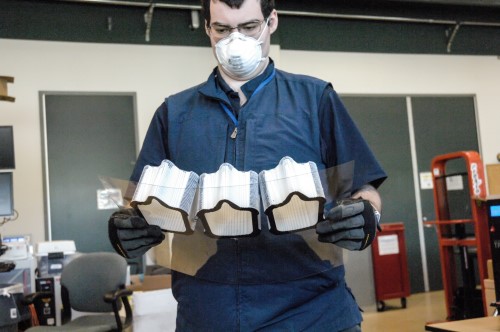
The time has arrived for manufacturers to reopen their facilities and commence operations once again. Things will be very different than they were just two months ago, and in order to safeguard your employees and customers alike, you will need new procedures for the foreseeable future.
Federal guidelines laid out by the Trump administration allow for states to adopt a staggered and individualized approach based on their own infection and recovery rates. Due to this state-to-state variability, your company's specific guidelines will vary.
However, the following practices are based on CDC recommendations for safe operations of critical industries, manufacturers and suppliers.
To best prepare your facility for reopening and to maximize health and safety, be sure you establish a plan of action well in advance of reopening day. This situation requires careful consideration, so taking every extra precautionary measure will only help you stay safe and successful.
Population Density
A hard cap on the number of people in any enclosed environment is the easiest way to limit potential exposure. Depending on your state and the size of the room in question, this may be 10 people, 50 people or a larger number.
Alternatively, this limit may also be based on a percentage of capacity (for example, 25% of an office's normal capacity). The lower density of workers in a given area will also make it easier for everyone to practice social distancing.
Reducing Pathogen Spread
In many types of manufacturing, multiple individuals need to touch the same materials, tools or pieces of equipment. Due to this, there are multiple options for maintaining hygiene, including wiping down each item before using it and requiring that all employees wear gloves and masks.
Regardless of which options you select, personal protective equipment (PPE) along with proper use information - such as how to don and doff it safely - must be provided to employees. It is also recommended to implement an inventory system to ensure that supplies of PPE are never depleted.
Additionally, if possible, install protective screens between workstations to prevent airborne pathogens from directly impacting other employees. These should be made of the proper shatterproof materials and arranged so that they do not create a safety hazard.
Furthermore, where safety allows, prop doors open to reduce the risk of contamination from handles. Noise and ventilation concerns may make this recommendation impractical for certain facilities, so exercise sound judgment.
Avoiding Bottlenecks
Try to stagger employee arrival and departure times to avoid a large congregation of people all trying to enter or exit at the same time.
This shift may require changes to operational startup and shutdown procedures. If you manage employee hours by a time card machine or digital equivalent, consider assigning one person to the machine to reduce the number of people touching it.
Moreover, common areas such as break rooms and cafeterias should either be closed or limited to a minimum number of people. Break times and lunches can be modified to avoid everyone congregating simultaneously.
Deliveries
Deliveries of materials should be accomplished through contactless methods. This requires a dedicated room for drop-offs that can later be processed by employees wearing PPE. You will also need to modify signatory protocols so that all deliveries are digitally signed for to avoid contact.
Temperature Monitoring
According to EEOC regulations, using an infrared thermometer to take employee temperatures before entering the work area is allowed. However, take care to ensure that this check is performed in a private area so that results are not overheard by others. Federal regulations still apply to personal medical information, which includes body temperature.
Contact Tracing
Limited contact tracing can be useful in helping to restrict the spread of the virus.
Employees who suffer acute symptoms that are similar to those expected from a COVID-19 infection or who test positive should notify Human Resources immediately. At this point, the affected individual can help identify other employees and even third-party vendors who they have come in contact with.
Be sure to notify these employees of their potential exposure in private.
Consult the Experts
If you're in search of specific industrial supplies and services to help your company transition, start your search on IndustryNet. The online industrial marketplace lists 400,000 manufacturers and suppliers of more than 10,000 products and services, including cleaning and janitorial companies, products and supplies; personal protective equipment; safety gear & consultants; legal services and more. Request a quote directly from the site, message a company, download catalogs and more.
