With the shift in B2B purchasing habits to online experiences, are manufacturers keeping pace with today’s buyers?
To find the answer, Winbound, a digital sales and marketing agency, collaborated with MNI and Polymath Research to create the “2023 Manufacturing Content Benchmark Report.”
The goal of the research was to determine if manufacturers were producing the type of online content B2B buyers are using in their buying process. The results showed that much of the industry is not producing the types of content that have proven successful in the customer journey.
In fact, many manufacturers aren’t producing online content at all.
The Shift to Online Buying Habits Continues to Grow
Before we take a look at the research findings, let’s examine the shift of the B2B buyer to digital.
Gartner reports that 80% of B2B sales interactions between suppliers and buyers will occur in digital channels by 2025, and only 17% of the total purchase journey will be spent meeting with potential suppliers.
B2B customers are using digital content to inform their buyer journey, conducting research on their own before reaching out to a sales team. The good news is that manufacturers who are producing content to meet these new buying habits are achieving success.
In fact, a Content Marketing Institute (CMI) report in late 2022 highlighted the areas of success achieved by manufacturers using digital content, including 88% in brand awareness, 67% in building credibility/trust, and 63% in educating their audience.
But just how many manufacturers were actually producing content for this type of approach?
Manufacturers Aren’t Reacting to the Trend
Our study reviewed the content on over 420 manufacturing websites of small, medium, and large companies based on revenue size.
Even though manufacturing typically lags behind other industries when it comes to marketing, we were still surprised by the results. Overall, fewer than half of manufacturers had a full complement of the types of digital marketing tools proven to be effective in content marketing.
(Surprisingly, while larger companies were more likely to have all components of a content marketing program, the gaps between them and smaller companies were not substantial.)
Here are some of the key findings as we looked at content as it applies to three areas of the customer journey.
Top-of-Funnel Content: Creating Awareness
Key Finding:
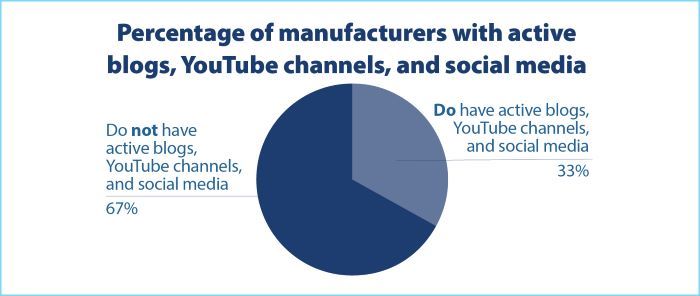
● Only 33% of manufacturers had regularly updated top-of-funnel content, which is typically found on blogs, YouTube channels, or social media.
Importance:
This type of content is critical because it’s what customers first encounter when they’re using search engines or social media to find answers to their problems. It usually focuses on customer problems, and creates awareness among prospects looking for solutions.
Middle-of-Funnel Content: Providing Insights
Key finding:
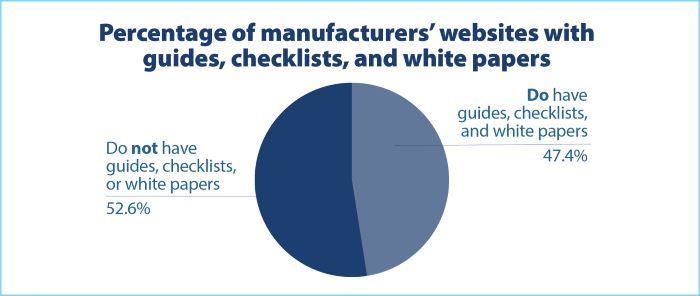
● 47.4% of manufacturers provided white papers, guides, and tools like configurators.
Importance:
This type of content provides new insights on how prospects can improve their business. These insights are critical for moving companies from the status quo, and includes data that informs complex buying decisions. White papers are a good example of middle-of-funnel content.
Bottom-of-Funnel Content: Building Trust
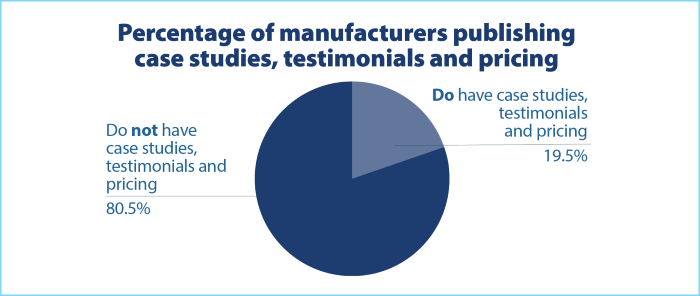
● Only 19.5% published case studies, testimonials, and pricing.
Importance:
Case studies and testimonials were underutilized, especially by smaller manufacturers. These trust-building assets are essential; 62% of B2B buyers cite the need for valid sources offering third-party perspectives.
Takeaways: The Best Time to Plant a Tree…
This research highlights a significant digital content gap in manufacturing marketing, but there are some positive indicators that some are reacting to the trends with success.
The Wheel Doesn’t Need to Be Reinvented
Content marketing success is already occurring, both inside and outside the industry. The CMI report mentioned earlier indicates that 81% of manufacturers who use content have experienced some degree of success.
Other B2B industries are using content marketing to generate sales and revenue: According to CMI, 62% of top-performing B2B marketers have used content marketing to successfully generate sales/revenue in the last 12 months.
Content Alone Is Insufficient
Merely having content assets is not enough. According to the 2022 CMI report, only 33% of manufacturers reported driving leads from their content marketing efforts.
A primary reason for the shortcoming is a lack of sales and marketing alignment; without it, marketing will simply be producing leads that sales doesn’t want and can’t close.
Golden Opportunity for Growth
Opportunity, in this case, is in the eye of the beholder. Some manufacturers might view the lack of content marketing by their peers as an indicator that an initiative isn’t required. But that’s akin to finding a new, lucrative sales territory, and not assigning it to a salesperson.
For manufacturers not currently leveraging content, the study suggests a golden opportunity to get a leg up on the competition. For those already creating content, the emphasis should be on maintaining momentum and widening the gap against competitors.
When Is the Best Time for Manufacturers to Start Generating Content?
The manufacturing sector stands at a pivotal moment, and embracing digital content strategies could be the key to unlocking growth in an increasingly digital world. Blueprints for success already exist; it’s just a matter of finding one that works for your company and launching an initiative.
As the proverb goes, the best time to plant a tree was twenty years ago. The second best time is now.
Looking to promote your business online? Learn more about IndustryNet’s marketing solutions.
The report was created by Winbound: A digital sales and marketing agency; Polymath Research + Marketing (PR+M): PR+M is a market-research and marketing firm; and MNI: Serving as the compiler and publisher of detailed profiles of the nation’s 400,000 manufacturers. This article was written by Greg Mischio of Winbound.