


Two years have passed since the CHIPS and Science Act, commonly known as the CHIPS Act, was signed into law on August 9th of 2022. Short for “Creating Helpful Incentives to Produce Semiconductors,” the CHIPS act was designed to rejuvenate the U.S. semiconductor industry—a sector that is essential for modern electronics, national security, and economic prosperity. The act was conceived in response to vulnerabilities in the semiconductor supply chain exposed by the global chip shortage amid the pandemic, with a focus on boosting U.S. competitiveness in advanced manufacturing and technology.
Now that we’ve reached the two-year anniversary of this landmark legislation, how has the CHIPS Act improved the U.S. semiconductor supply chain and what has been the downside? This article will take an in-depth look at the CHIPS Act, its impact on the U.S. manufacturing sector and explore some specific success stories in the industry.
The Basics of the CHIPS ACT
One of the CHIPS Act's primary objectives was to reduce the U.S.'s reliance on foreign suppliers, particularly those in geopolitically sensitive regions. By investing in domestic chip production, the act aimed to safeguard supply chains for critical technologies used in defense, telecommunications, and other vital sectors. This strategic move has enhanced national security by ensuring that key components remain under U.S. control, thereby contributing to economic stability.
To incentivize this shift, the CHIPS Act provided substantial financial support, including $39 billion in tax benefits, loan guarantees, and grants administered by the Department of Commerce. These incentives were designed to encourage American companies to build new chip manufacturing plants on U.S. soil. Additionally, $11 billion was allocated for advanced semiconductor research and development. Despite these efforts, some experts argue that the act has primarily benefited large, established companies, potentially stifling innovation and missing opportunities to support smaller, more agile firms that could drive the next wave of technological breakthroughs.
Progress & Roadblocks: Measuring the Success of the CHIPS Act
The CHIPS Act has not been without challenges. Critics have raised concerns about the substantial price tag and the potential for deficit spending to drive up inflation. Some experts argue that the CHIPS Act, while designed to boost U.S. semiconductor manufacturing, may be missing the mark by primarily benefiting large, established companies that have lost their competitive edge. Critics suggest that this focus might not drive the innovation needed to surpass leading Asian foundries, which are known for their cutting-edge technology and superior customer service.
Moore’s Law, which predicts that the number of transistors on a microchip will double approximately every two years, has been a guiding principle in the semiconductor industry. However, as physical limitations slow this pace, the industry faces new challenges. There’s a growing call to direct more funding towards smaller, agile companies that are pioneering innovative solutions. These firms could be key to overcoming current limitations and reclaiming U.S. leadership in semiconductor technology.
Furthermore, while the act has spurred significant private sector investment—totaling over $450 billion according to the Semiconductor Industry Association—some projects have faced delays. A Financial Times investigation revealed that roughly 40% of the investments announced by the Biden Administration as a result of the CHIPS and Inflation Reduction Acts have been delayed or paused indefinitely. Some of the largest projects that are experiencing delays include Enel’s solar panel facility in Oklahoma, LG Energy Solution’s battery storage facility in Arizona, and Taiwan Semiconductor Manufacturing Company in Casa Grande, Arizona.
As the funding is doled out based on construction and Part of the issue, the study states, is companies are required to achieve a certain level of production and construction milestones before they can receive funding. Market conditions, supply chain issues, and a lack of skilled workers are also among the factors contributing to these setbacks.
Despite these hurdles, the CHIPS Act has catalyzed a wave of development in the semiconductor space. The Commerce Department has announced over $30 billion in proposed CHIPS private sector investments, spanning 23 projects in 15 states. Meanwhile, according to a recent Biden Administration press release, two years ago, the U.S. produced none of the world's most advanced chips. Today, America hosts all five of the leading-edge logic, memory, and advanced packaging providers, positioning the U.S. to produce nearly 30% of the global supply of leading-edge chips by 2032.

CHIPS Act Impact: Key Projects in the Works
Now that we’re two years in, what are some key projects in the works? Let’s take a look:
Texas Instruments has announced plans to build a new semiconductor chip factory in Lehi, Utah, marking the largest private investment in the state's history. The $11 billion project is expected to create 800 direct jobs and thousands of additional indirect jobs.
Intel Corporation announced plans to build its most advanced semiconductor manufacturing facilities in the state. Intel plans to invest over $20 billion to construct two plants by 2025, marking the largest private sector investment in Ohio's history.
Taiwan Semiconductor Manufacturing Company (TSMC) announced a second fabrication facility in the state, which will start producing 3nm process technology in 2026. This new plant, alongside another facility set to begin N4 process technology production in 2024, represents a combined $40 billion investment—the largest direct foreign investment in Arizona’s history.
Also in Arizona, Saras Micro Devices celebrated the grand opening of its new headquarters and manufacturing facility in Chandler, Arizona. The company relocated from Atlanta, Georgia, to leverage the region's growing semiconductor ecosystem and support its expansion in the HPC AI/ML sectors.
Micron Technology announced plans to build the largest semiconductor fabrication facility in the U.S. in Clay, New York. This "megafab" will significantly boost the supply of leading-edge memory chips and is expected to create 50,000 jobs in the region, including 9,000 directly with Micron. The project represents a $100 billion investment, marking the largest private investment in New York's history.
Additionally, the Semiconductor Industry Association has tracked the following projects:
• Microchip in Colorado Springs, CO; $880 million investment, 400 jobs
• Western Digital in Fremont, CA; $350 million investment, 240 jobs
• Akash Systems in Oakland, CA; $432 million investment, 500 jobs
• Bosch in Roseville, CA; $1.2 billion investment, 140 jobs
• EPM Shield in Burlington, KS; $1.9 billion investment, 1,200 jobs
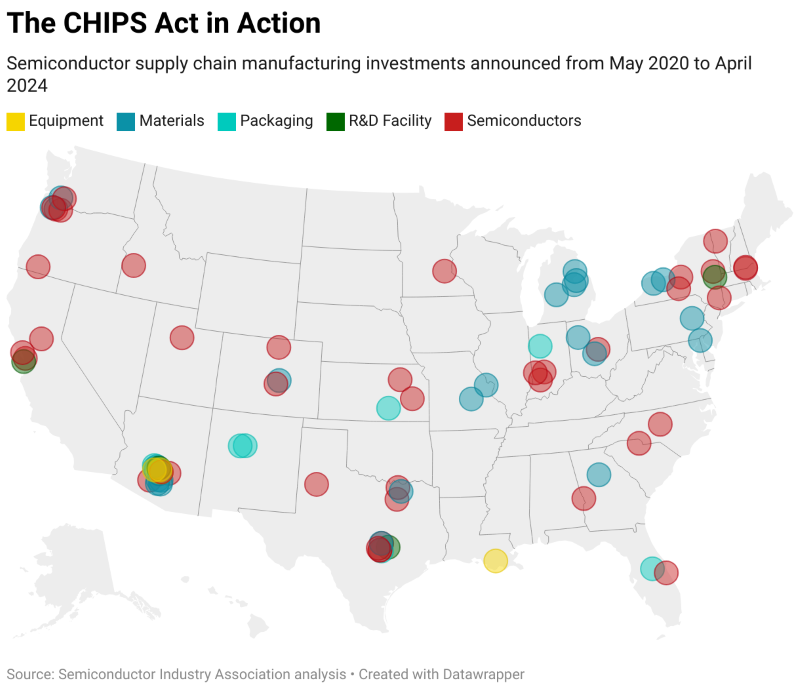
See the SIA list for more.
Fueling EV: CHIPS' Impact on the Battery Belt
One of the most significant outcomes of the CHIPS Act has been the emergence of the "battery belt"—a corridor of economic activity and industrial development focused on battery production and associated technologies. This development is particularly noteworthy as it represents a strategic shift toward securing the supply chain for electric vehicles (EVs) and renewable energy storage solutions. The "battery belt" is not just a single hotspot but a network of facilities and initiatives across multiple states, fueled by investments from both the CHIPS Act and other legislative measures like the Bipartisan Infrastructure Law and the Inflation Reduction Act. The synergy between the CHIPS Act and the development of the "battery belt" is evident in the substantial investments in EV battery production, which have increased by 700% since the start of 2021. With the CHIPS Act providing $52.7 billion to establish a reliable domestic supply chain, the U.S. is well-positioned to meet the growing demand for EVs and their ccritical components.
Summing Up
Two years in, the CHIPS Act has laid a strong foundation for future innovation and growth. Major facilities are under construction, and the act has catalyzed economic growth, including the emergence of a "battery belt" focused on EV and renewable energy technologies. However, the act has faced challenges, including criticisms that it favors large companies over smaller innovators, as well as delays due to skilled labor shortages and supply chain disruptions. Despite these hurdles, the CHIPS Act remains pivotal in securing U.S. technological leadership and economic security.
