

Air is an essential part of life on this planet. It is also an essential ingredient for the operation of many plants. Whether supplying air to machinery or evacuating air from a process, air is one of the four essential utilities in many manufacturing operations.
Vacuum pumps are widely applied in the manufacturing of plastics in various applications, mainly to extract gases and vapor. If you are utilizing vacuum to evacuate air in your plant, then this is a must read for you.
General Industries Using Vacuum Pumps

The focus of this article is on vacuum applications in the plastics industries in general with a specific focus on the boat building and repairing industry.
This industry has some unique challenges in utilizing vacuum pumps in order to achieve the required vacuum levels at the highest possible efficiency rates, thus keeping the energy consumption to the lowest possible levels.
Plastics Industries
When we start looking at applications that utilize vacuum in any plant, there are two general classifications: Passive and Active. In this industry the applications are:
Passive:
• EPS Foaming
• Pneumatic conveying
Active:
• Calibration
• Degassing extruders
• EPS-Foaming
• Pneumatic conveying
• Thermoforming
Each one of these applications require a certain vacuum level in order to operate at optimal design. The challenge is to try and match the application to the appropriate vacuum pump technology as they all have limitations on how much vacuum they can pull.
Vacuum Levels
We all know that that there is no one type of pump that can work on all applications. This is no different for vacuum pumps. To understand this, we must first define what vacuum is and the different levels of vacuum or vacuum range that we typically see in most applications.
A vacuum is any pressure below standard atmospheric pressure of 29.92“Hg absolute, or 1 bar.
An “ideal vacuum condition” is defined as a space from which all air and other gases have been removed.
A “perfect vacuum” has never been obtained. Even in the depths of outer space there is roughly one particle (atom/molecule) per cubic centimeter of space.
When lifting an object up with “vacuum”, it is not the vacuum inside the suction cup that provides the lifting or holding force. It is actually the atmospheric pressure on the opposite side pushing the object onto the suction device that provides the lifting or holding force.
The following chart provides a good visual between positive and negative pressure (vacuum) readings:
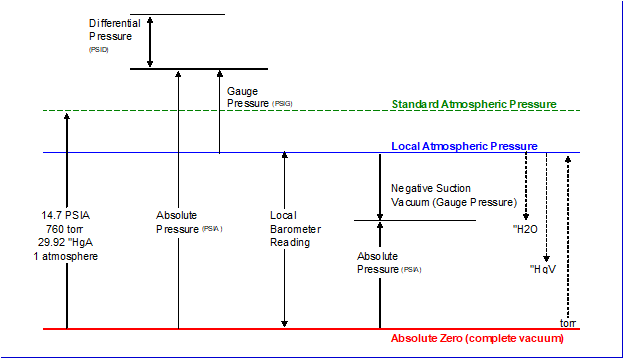
This table gives a general definition of vacuum regions:
Rough Vacuum: 760 torr to 1 torr
Medium Vacuum: 1 torr to 10¯³ torr
High Vacuum: 10¯³ torr to 10¯7 torr
Ultra-high Vacuum: 10¯7 torr and below
Vacuum Pump Technologies
Now that we defined what a vacuum is, let us look at the various types of vacuum pumps that are available in the market. You will note that there are several types of vacuum pump technologies available that can be used in the Plastics Industries. The application will dictate what type of technology to use.
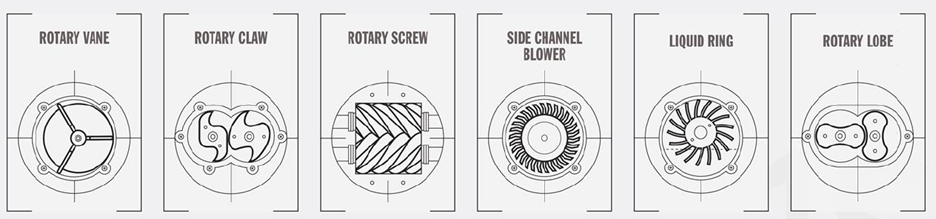
Rotary Vane
• Deep vacuum levels
• Compact footprint
• Low noise levels
• Long life vanes
• Oil-free or lubricated designs
• Extended maintenance intervals, less downtime
Rotary Claw
• Contact-less operation
• Oil-free compression
• Highly efficient
• No wearing parts
• Minimal maintenance, service intervals up to 5 years
Rotary Screw
• Continuous variable pitch screws
• Contact-less design
• Sort evacuation times
• Oil-free compression
• High water vapor tolerance
Side Channel
• Contact-less operation
• Quiet Operation
• Tolerant to dust ingestion
• UL/CSA approved
• Extended maintenance intervals
Liquid Ring
• High resistance to corrosion
• Contact-less operation
• Increased water carry-over models
• UL/CSA approved
• Available in partial or closed circulation
Pump Selection Chart

Expert Solutions
It should be clear that there is no one vacuum pump type that can be used on all applications. You need a partner that understands the vacuum/pressure function in the process/application, and then identify which pump technology is ideal for each application.
Our experienced sales team will recommend the best solution for your specific application. Whether it is a standalone vacuum pump or a vacuum system, our goal is to give you the most efficient solution from the most advanced products available in the market.
We welcome the opportunity to partner with you on your next project. For more information, please visit our website: www.pyebarker.com or contact us at sales@pyebarker.com.
