

Your buyers have started asking ChatGPT who to buy from. Procurement managers ask it to shortlist suppliers, plant engineers ask which coating survives salt spray, which gasket material handles 400°F, which regional distributor stocks metric fasteners. And when AI answers those questions, it names specific companies, usually three to five of them, presented as the answer rather than a page of links to evaluate.
Here is the uncomfortable part: at Gushwork we have now run these buyer questions for 1,200 plus industrial companies, and most of them appear in none of the answers. Not because AI engines dislike them, but because their websites give the engines nothing to cite. The companies that do get named are rarely the biggest. They are the ones whose websites happen to answer questions the way AI systems need them answered.
The good news is that this is fixable, it is largely mechanical, and right now, in most industrial niches, almost nobody is doing it. This article covers what we have learned building AI visibility for industrial companies: how the engines choose who to cite, and what a manufacturer can do about it, starting this quarter.
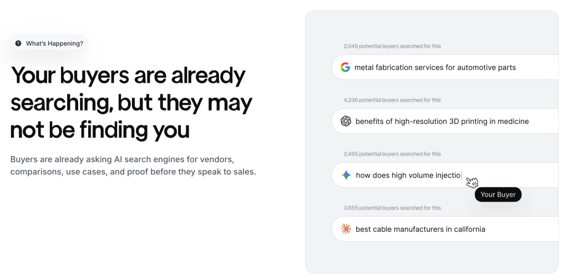
How AI Engines Actually Decide Who to Recommend
To influence the answer, you need to know how it gets assembled. When someone asks ChatGPT, Perplexity, or Google's AI Overviews a buying question, two things happen:
First, the model draws on what it already "knows" - patterns absorbed from its training data. If your company is described consistently across many credible websites, the model has an internal sense of who you are and what you make. If your web presence is thin, you barely exist in its memory.
Second, and more importantly for commercial questions: the engine searches the live web, reads a handful of pages, and composes its answer from them, citing sources. This is called retrieval, and it is how most buying-intent questions get answered today. The engine is skimming a few pages that its search step surfaced, extracting the passages that most directly answer the question, and naming the companies those passages mention.
The practical implication: you do not need to wait years for an AI model to "learn" about you. You need pages that get retrieved and passages that are worth extracting. In our customers' experience, that can happen in weeks, not years.
What Gets a Page Cited: 4 Mechanics
1. Build answer pages, not brochure pages
The typical manufacturer website has a home page, an "About Us," a capabilities page, and a products section. These pages are written for humans who already found you. AI engines retrieve pages that match questions, and a capabilities page matches almost none.
Every distinct question your buyers ask deserves its own page that answers it directly: "What's the difference between electropolishing and passivation?" "What tolerances can Swiss machining hold?" "Best abrasives supplier for aerospace composites."
Companies that publish fifty of these pages give the engines fifty chances to retrieve them.
Companies with a brochure site give them roughly zero.
2. Structure for extraction
AI engines are skimming machines. Pages that get cited share a recognizable anatomy:
- The direct answer appears in the first paragraph - not after 300 words of preamble about your founding in 1962.
- Headers are phrased as the questions buyers ask, because retrieval matches question-shaped queries to question-shaped headers.
- Specifications live in tables, not paragraphs. Materials, tolerances, temperature ranges, lead times, MOQs, certifications. Tabular data is the easiest thing on the internet for an AI to extract and repeat.
- An FAQ section catches the long-tail phrasings of the same question.
None of this is exotic. It is the difference between writing for a reader who already trusts you and writing for a machine deciding whether to introduce you.
3. Do not block the crawlers reading your site
A surprising number of industrial websites block AI crawlers in their robots.txt file - sometimes deliberately, often because a web vendor applied a blanket setting. If GPTBot, OAI-SearchBot, PerplexityBot, or ClaudeBot cannot read your pages, you have opted out of the answers. Two more technical basics: content should be present in the page HTML rather than assembled entirely by JavaScript after load, and pages should be fast. Have whoever manages your website check this. It takes ten minutes and it is the cheapest fix in this entire article.
4. Cover the long questions, because that is where AI answers are thin
When an engine answers a broad question, it quietly runs many narrower searches behind the scenes - variations, comparisons, spec-level sub-questions. In consumer categories, every one of those sub-questions has a thousand competing sources. In industrial categories, many have almost none. "Best accounting software" is a bloodbath; "lead time for custom extruded silicone gaskets" might have three usable sources on the entire internet. Publish a competent answer to a thin question and you are not fighting for position - you are often the only credible source the engine can find.
This is where the fastest wins in our customer base come from: pages targeting thin, specific buyer questions that get cited within weeks because nothing better exists. It is the structural advantage industrial companies have over every crowded consumer market, and it is why unglamorous niches are winning AI visibility disproportionately right now.
How to Check Where You Stand
You do not need tools to start measuring. Write down the ten to fifteen questions your real buyers ask - the ones your sales team hears on calls. Ask them, phrased naturally, in ChatGPT, Perplexity, and Google's AI mode. Record who gets named. Repeat monthly.
Three things typically surprise manufacturers doing this for the first time: how often their competitors' names appear, how often the "recommended" companies are smaller firms with better-structured websites, and how differently the engines answer the same question. Which is itself the point: every engine is drawing from whatever citable sources exist, and in thin niches, a single well-built page can change the answer.
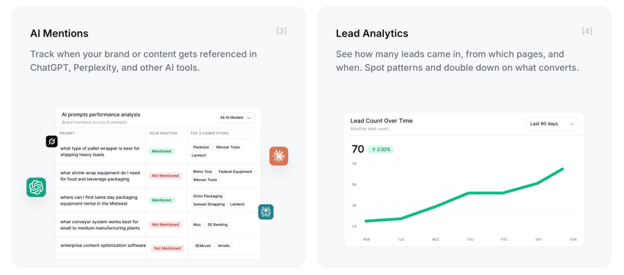
(If you would rather not do this by hand, this is exactly what Gushwork's free AI Search Grader automates - it asks the engines the questions your buyers ask, shows you where you and your competitors get cited, and tracks how the answers move. Book a free Digital Strategy call to get a sneak peek.)
What to Expect, Honestly
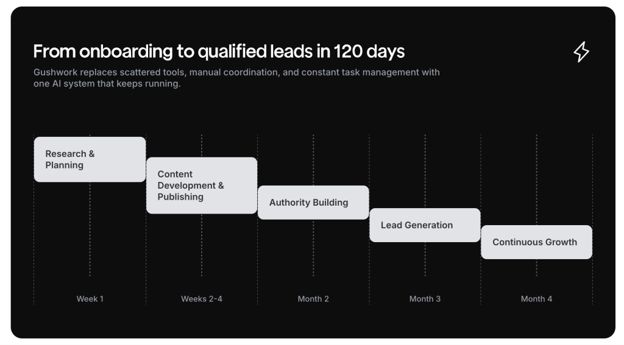
This is not instant. In our customers' experience, new pages begin appearing in AI answers over roughly 45 to 60 days - faster in thin niches, slower where established sources exist.
Here is what that looks like in practice:
1. Source Equipment, a New England industrial equipment supplier, came to Gushwork with a website drawing two to three visits a month and producing zero inbound leads. Within two months of answer pages going live, the site was pulling 600+ monthly visitors and 40+ qualified leads per month with buyers finding the company through Google and AI engines like ChatGPT and Perplexity, including national buyers who would never have discovered a regional supplier through word of mouth.
2. John Maye, a packaging equipment distributor that had run on relationships for 40 years, started getting found when plant managers asked ChatGPT who sells case erectors in the Midwest — 25+ inbound leads in the first 30 days.
And the answers keep moving as engines update, models change, and competitors publish. AI visibility behaves less like a billboard you buy once and more like a position you hold - which is why the pages have to be maintained, not just launched.
The Part Nobody Tells You: The Math of Doing This at Scale
Everything above is doable by hand. One well-structured answer page is a weekend project for someone on your team, and if you have never done this, that weekend is worth spending.
The catch is arithmetic. A typical manufacturer's buyers ask hundreds of distinct questions, each engine re-checks its sources continuously, and every page needs to be researched, structured, published, and kept current. Winning one question is craftsmanship; winning three hundred is an operations problem.
That operations problem is what we built Gushwork to solve. Our AI agents do the competitor and keyword research, map every question your buyers ask, build the answer pages in your brand's own voice, publish them on your domain, and keep them updated as the engines change - a hundred or more buyer questions covered, typically for less than what a single trade-show booth costs, with the leads those pages generate reported back to you automatically.
If you want to see where you stand before deciding whether any of this is worth your time: we will run the full audit for you, free - the exact questions your buyers ask, asked to the engines, with screenshots of who gets cited and who does not. And we will build your first five answer pages free, live on your website, yours to keep whether or not you ever pay us a dollar. Book a free Digital Strategy call today!
Rahul Chauhan is Director of Growth at Gushwork (backed by Lightspeed and SIG), which builds AI-powered lead generation for industrial and B2B companies - targeted content, landing pages, and AI-led leads at scale. Start with the free Digital Strategy call today!
