

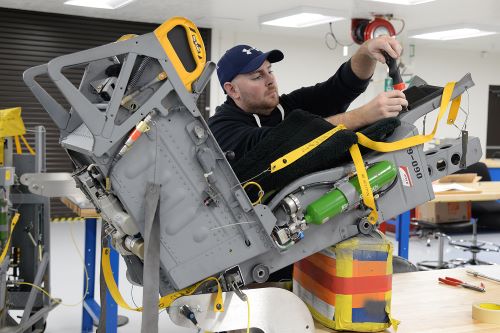
Photo credit: Hill Air Force Base
3 MIN. READ
Springs are by definition energy storage devices. Made of elastic material coiled in a specific way, they are used in a wide variety of machines and products.
Springs can operate in several different modes depending on the application. Keep reading for some basic facts about springs, the spring manufacturing industry and how to find a spring supplier.
Spring Basics
Springs are classified by either their force type or design. The most often thought of example is the tension spring, which gets longer when a force is applied to one or both ends of it. Another popular type is the compression spring, which, as its name suggests, gets shorter when a force is applied.
Both of these variants are widely used in the automotive, firearms and upholstery industries.
One of the most common construction materials is spring steel, which has a very high yield strength, allowing for non-permanent elastic deformation under load. Partly due to the increase in domestic steel production, raw material import rates are relatively low.
Compared to manufacturing as a whole, the spring sector imports slightly more raw materials by percentage. About 18% of the materials used in spring manufacturing comes from other countries, as opposed to 11%.
The Spring Industry
Springs are used all over the world, and as a result, international distribution is relatively high. There is a near 50/50 split between domestic and international distribution. By comparison, manufacturing overall only distributes 29% globally.
Ownership and management are largely on par with the rest of manufacturing. About 6% of companies are publicly held, just 1% more than the overall industry.
Women- and minority-owned companies account for 3% and 1% respectively, also in alignment with all of manufacturing.
The locations of the 413 companies that make up the spring industry are pretty evenly distributed among three regions. The Midwest accounts for 40% of all spring companies.
The regions of the South, West and Northeast share the remainder of companies with 22%, 18% and 20% respectively.
Sourcing Spring Suppliers
Before contacting a spring manufacturer, you first need to understand the mechanics of the device that requires them. Will it be used for damping vibrations, such as a vehicle shock absorber?
Or will it be used to convert torque, such as in garage door torsion springs? Knowing the use will help the manufacturer determine the specifications and materials required.
Depending on the uniqueness of the design, they may suggest engineering and fabricating a special solution or using a stock spring that fits the parameters already.
Once these data points are known, it is time to connect with a provider to get pricing. Getting a quote on your spring order can be more effective if multiple companies are contacted.
IndustryNet provides free information on nearly 400,000 manufacturers, helping industrial buyers connect with suppliers. Users can search, source, quote and email for free directly from the site. This data is researched and compiled by a team of 80 professional researchers to ensure you get only the most up to date information. With 11,000 product and service categories, you are sure to find what you are looking for. Set up a free account and get searching today!
