

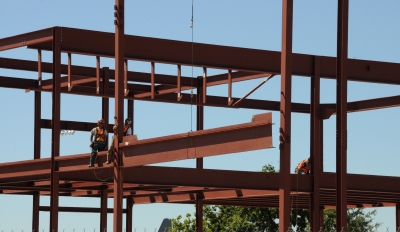
 Every person in the United States is reliant on construction machinery to create the buildings and infrastructure that make up our cities and towns.
The companies that manufacture these machines are currently in the midst of a challenging period as international trade actions ripple into their market.
We will address some of these issues and explore how this important industry has weathered the storm.
International Influences
The trade war of 2018 between the United States and China had a ripple effect on the construction machinery industry. Considering the heavy-duty nature of much of the machines, the structural materials of choice are metals such as steel and aluminum.
Not only were these materials high on the list of items subject to significant tariffs, but a relatively large percentage, 19%, of companies import raw materials.
To add to this impact, construction machinery itself was placed under tariff by both nations. The final effect was tied to multiple factors, the most important of which were the amount of tariffed materials used in the completed product, the number of international customers (read: Chinese customers) and the manufacturer's ability to shift supply chains.
Leading Manufacturing Growth
Overall, the industry was able to escape with only a 0.39% loss in sales, according to inofrmation collected by MNI, publisher of the industrial data that powers IndustryNet.
The market is currently worth $55.2 billion versus $55.4 billion the previous year. Total jobs increased significantly to 66,975, conflating to a 6.03% boost. This is balanced against 8% of the companies in the industry reporting employment gains and 3% reporting employment losses.
Sales growth also outpaced the rest of manufacturing with 3% reporting growth versus only 1% averaged over the rest of the industry. This is impressive considering that construction machinery manufacturers distribute internationally far more than the overall manufacturing industry, with 54% being heavily involved in trade beyond our borders.
Company Locations and Sizes
Like many other heavy equipment manufacturers, the majority of construction machinery companies are based in the Midwest, with 358, or 40%, located in this region.
The next most populous region is the South with 32%. Trailing far behind is the West with 17% and the Northeast with only 11%. The overwhelming majority of these firms are privately held with only 10% existing as public companies. The largest companies employ tens of thousands of people overall with several thousand usually occupying a single site or location.
Innovation
The construction machinery industry has weathered ups and downs for decades. However, it is now experiencing a rapid increase in the level of technological innovations that are being incorporated. Many of them deal with automation and remote control of machines that traditionally needed a dedicated operator.
Additionally, environmental concerns are addressed through the implementation of hybrid power sources for machines such as backhoes, excavators and bulldozers. Along with being lower on emissions, these hybrid systems can recover what is traditionally wasted energy during normal operations.
No discussion of innovation would be complete without mentioning the Internet of Things, or IoT. How IoT ties in to construction machinery is in the enhanced real-time equipment fault monitoring, virtual and augmented reality for operators to allow for extreme accuracy, autonomous vehicles that know where to dig or place materials and the ability to network to an entire job site to maximize efficiency.
Click here to see a full listing of construction machinery manufacturers on IndustryNet.
