

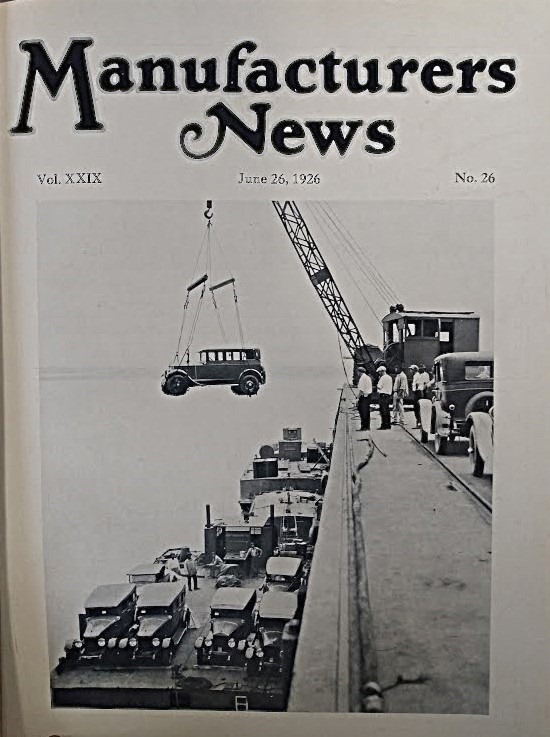
America's manufacturing story started long before the first factory, in a blacksmith's forge, a cooper's bench, and a network of individual craftsmen who made what their communities needed, one piece at a time. Two hundred and fifty years later, that same instinct, build what's needed, build it well, build it here, still drives an industrial base that generates nearly $2.9 trillion in annual output and remains one of the largest manufacturing economies on earth.
MNI has been documenting American industry since long before "supply chain" was a household phrase. The images throughout this piece come from our own archives, pages of Manufacturers News dating back to the 1920s and 1930s, when the assembly line was still a novelty and the airplane was barely older than some of the men photographed building it. Looking at these images alongside today's reshoring headlines, the throughline is hard to miss: American manufacturing has reinvented itself again and again, and it is doing so again right now.
Just in time for America's big 250th birthday, this Independence Day, we're tracing that 250-year arc in five chapters.
Chapter One: Colonial Craft (1776-1820s)
At the founding, American manufacturing was a matter of individual skill rather than industrial scale. Blacksmiths forged tools and hardware. Coopers built barrels for shipping flour, whiskey, and salted fish. Textile production happened largely in homes, on spinning wheels and hand looms, with the output measured in yards rather than tons. The Founding Fathers themselves were often manufacturers in this sense: George Washington operated a distillery and a gristmill at Mount Vernon, Paul Revere ran a metalworking shop that produced everything from silverware to cannon, and Benjamin Franklin printed and bound his own publications.
What these early manufacturers shared with today's IndustryNet suppliers is more than nostalgia. It's the same basic proposition: a buyer needs something made, and a domestic producer with the right skill and the right tools can make it better, faster, or more reliably than an alternative shipped from somewhere else. In the 1770s, that alternative was a slow boat from England. Today it might be a slow boat from somewhere else entirely. The logic hasn't changed nearly as much as the technology around it.
Chapter Two: The Industrial Revolution (1820s-1900)
Water power and then steam power changed everything. Textile mills clustered along New England rivers. The Bessemer process made steel production fast and cheap, turning Pittsburgh and the Ohio Valley into the backbone of American heavy industry. Railroads tied the country together and created, for the first time, a genuinely national market for manufactured goods. By the end of the 19th century, the United States had overtaken Britain as the world's leading industrial power, a position built on coal, steel, and an enormous expansion of mechanized production.
This was also the era that gave rise to the modern industrial workforce and to the specialized supplier relationships that still define B2B manufacturing today. A steel mill needed castings, forgings, and machined parts from other companies. A railroad needed rolling stock, rail, and signal equipment from still others. The web of supplier relationships that IndustryNet exists to support today has its roots in exactly this period, when manufacturers first started needing structured ways to find each other.
Chapter Three: Mass Production (1900-1945)

The automobile pulled American manufacturing into a new era, and not always smoothly. The earliest self-propelled vehicles, like Nicolas Cugnot's 1770 steam-powered "first automobile," shown here crashing through an arsenal wall thanks to inadequate brakes, were closer to dangerous novelties than practical machines. It took more than a century of refinement before the automobile became something a factory could build at scale.
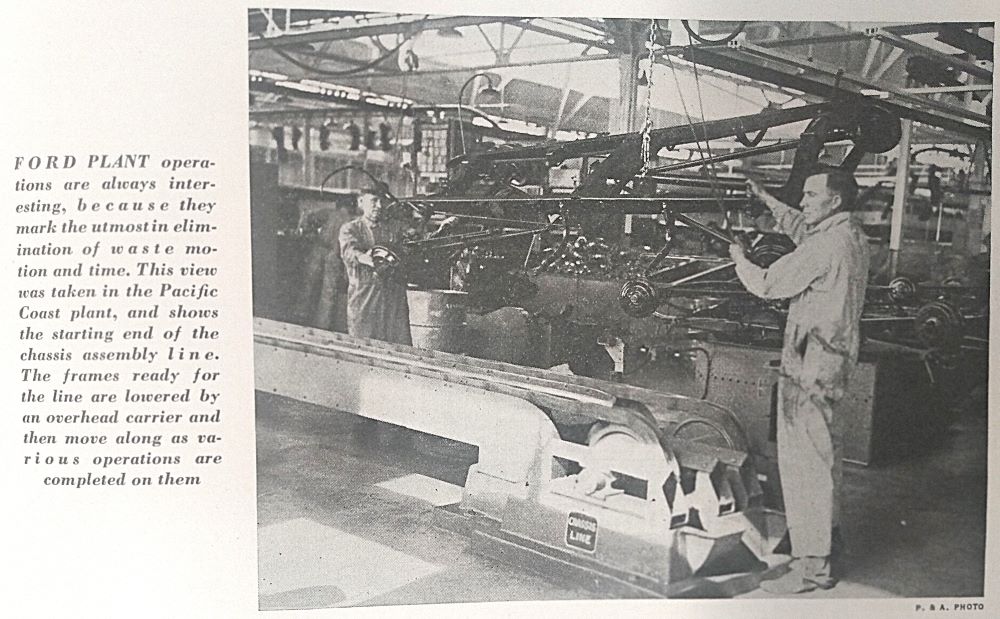
Henry Ford's moving assembly line, introduced in 1913, is the single most consequential idea in the history of American manufacturing. By breaking production into discrete, sequential steps and bringing the work to the worker rather than the other way around, Ford cut the time to build a Model T from roughly 12 hours to about 90 minutes. The photo above, from MNI's own archives, shows the starting end of a Ford chassis assembly line on the Pacific Coast: frames lowered by overhead carrier, moving along the line as operations are completed in sequence. The original caption called it a mark of "the utmost in elimination of waste motion and time," a phrase that could just as easily describe a modern lean manufacturing initiative.
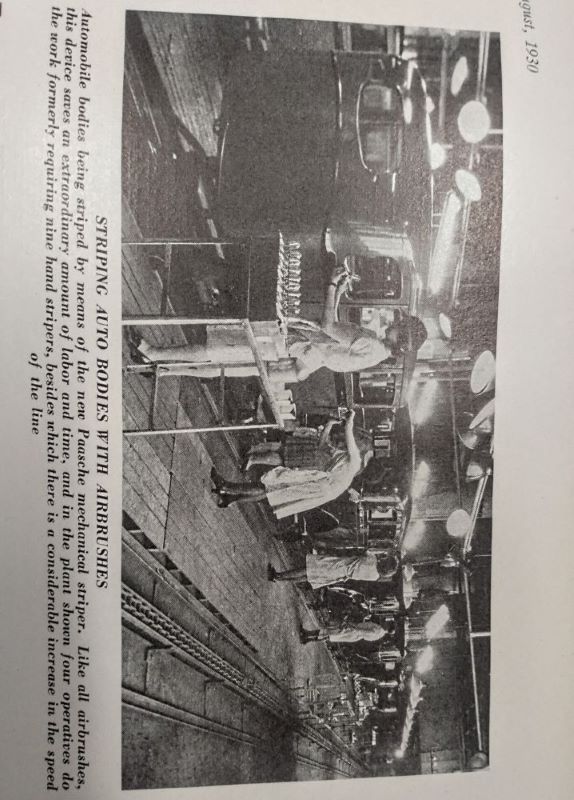
Mass production kept compounding on itself through the 1920s and 1930s. This August 1930 image shows automobile bodies being striped with a new mechanical airbrush device, the Paasche striper, which let four operators do work that had previously required nine hand stripers, while also speeding up the line. It's a small detail, but it captures something important: even in the earliest decades of mass production, manufacturers were constantly automating individual tasks to increase throughput, exactly the same instinct driving robotics and automation investment today.
Aviation manufacturing emerged in this same period as one of America's defining industrial strengths. This photo, from MNI's own Manufacturers News archives, shows the Boeing plant in Seattle at a moment the original caption called "America's largest plane factory," with 965 employees working around the clock to keep up with demand. Rows of biplane fuselages and wing assemblies fill the floor, built one frame at a time by hand.
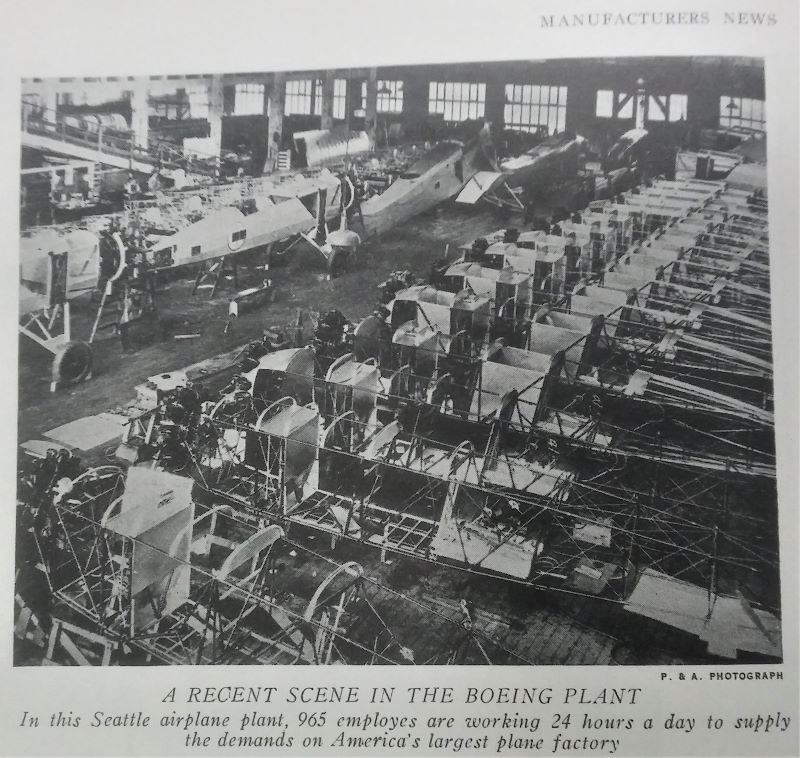
That very same Boeing plant today employs 30,000 workers, building some of the most complex machines on earth and anchoring a vast network of domestic suppliers that includes structural components, avionics, fasteners, and forgings sourced from manufacturers across the country. Aerospace remains one of the most distinctly American manufacturing sectors today, with the United States still leading the world in commercial and defense aircraft production.
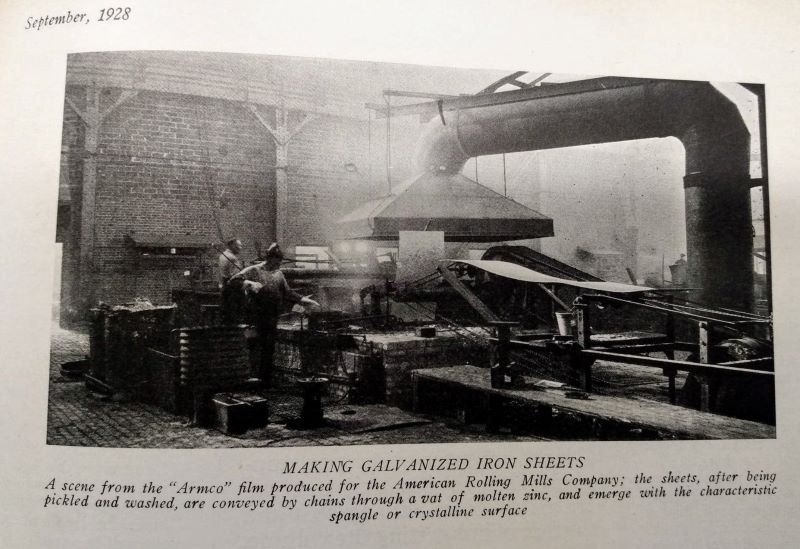
Heavy industry kept pace with consumer manufacturing. This September 1928 image from the American Rolling Mills Company (Armco) shows galvanized iron sheets being pickled, washed, and conveyed through a vat of molten zinc, emerging with the characteristic spangled surface still used in galvanizing today. The fundamentals of the process haven't changed much in nearly a century, even as the equipment and metallurgy have advanced considerably.
Chapter Four: Automation and Material Handling (1945-1990s)
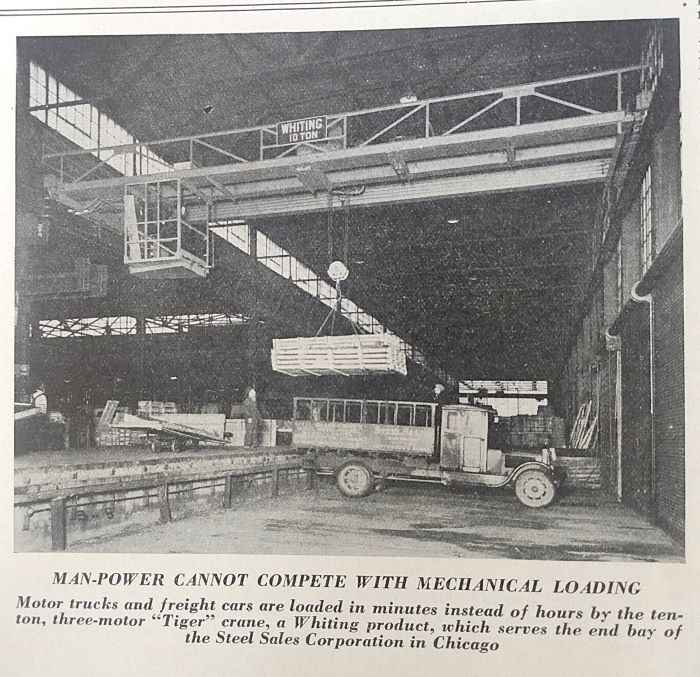
The postwar decades brought a steady, unglamorous revolution in how goods moved inside and between factories. This image shows a Whiting ten-ton "Tiger" crane loading a motor truck in minutes at the Steel Sales Corporation in Chicago, work that previously required far more time and far more manual labor. The original caption put it bluntly: "Man-power cannot compete with mechanical loading." That sentence, written decades before anyone used the term "automation," describes exactly the calculation manufacturers are still making today every time they evaluate a robotic arm, a conveyor system, or a warehouse automation investment.
This era also built the infrastructure of modern industrial supply chains: standardized containers, forklifts, palletizing, and eventually computerized inventory systems. Manufacturing didn't just get faster on the production line. It got faster in the warehouse, on the loading dock, and on the highway between supplier and customer.
Chapter Five: Reshoring and the Next 250 Years
American manufacturing spent the early 2000s losing ground to lower-cost overseas production. That trend has been reversing. The Reshoring Initiative tracked more than 244,000 reshoring and foreign direct investment jobs announced in 2024 alone, pushing the cumulative total past two million positions since 2010. Companies cite proximity to engineering teams, shorter lead times, and reduced supply chain risk as their leading reasons for bringing production back to the United States, a notable shift from the cost-driven calculus of decades past.
The tools have changed dramatically. Where a 1928 steel mill measured efficiency by how many fewer workers it took to load a truck, a 2026 manufacturer measures it through real-time inventory systems, AI-assisted quality control, and structured digital listings that help buyers find them in the first place.
IndustryNet's own role in that story, connecting 360,000-plus verified suppliers with the purchasing professionals who need them, is the modern version of the same basic function manufacturers have needed since Paul Revere first hung a sign outside his shop: a way for buyers to find the people who can actually make the thing.
That role has taken on a more formal dimension recently. IndustryNet is one of three featured marketplaces on the SBA's Make Onshoring Great Again Portal, a federal initiative aimed at making it easier for buyers to find domestic manufacturing capacity as reshoring accelerates. It's a fitting place for MNI to land at 250 years in: a business built to document American industry now playing a direct role in helping rebuild it.
Two hundred fifty years in, American manufacturing is still adapting, still automating, and still finding new reasons to build at home. The chapters keep getting written. Based on the pace of the last few years, the next one is already underway.
Find Domestic Manufacturers on IndustryNet
IndustryNet is a longstanding resource for locating U.S. manufacturers, suppliers, and industrial service providers. The directory includes detailed company profiles that are researched firsthand and is widely used by professionals across industrial sectors to find and connect with domestic production partners. IndustryNet is a product of MNI (Manufacturers' News, Inc.), which has been researching and publishing industrial data for over 110 years.
Search IndustryNet's directory of 360,000+ verified U.S. manufacturers and suppliers across 11,000+ product and service categories at industrynet.com or learn about how to include your company's listing here.
